





















Research: How AI-Powered 'Vibe Coding' Threatens the Open-Source Software Ecosystem
By
kgwgk

A bagel you'd recommend to a friend without hedging.
Summary
This academic paper examines how generative AI-powered 'vibe coding' affects the open-source software ecosystem. Vibe coding involves AI agents building software by selecting and assembling open-source components without direct user engagement with maintainers. The research finds that while vibe coding increases productivity by lowering the cost of using existing code, it weakens the user engagement that maintainers rely on for returns. When open-source is monetized only through direct user engagement, widespread vibe coding reduces entry and sharing, lowers the availability and quality of open-source software, and ultimately reduces welfare despite higher productivity. The paper concludes that sustaining open-source at its current scale under widespread vibe coding requires major changes in how maintainers are compensated.
Key quotes
· 5 pulledVibe coding raises productivity by lowering the cost of using and building on existing code, but it also weakens the user engagement through which many maintainers earn returns.
When OSS is monetized only through direct user engagement, greater adoption of vibe coding lowers entry and sharing, reduces the availability and quality of OSS, and reduces welfare despite higher productivity.
Sustaining OSS at its current scale under widespread vibe coding requires major changes in how maintainers are paid.
Generative AI is changing how software is produced and used. In vibe coding, an AI agent builds software by selecting and assembling open-source software (OSS), often without users directly reading documentation, reporting bugs, or otherwise engaging with maintainers.
We study the equilibrium effects of vibe coding on the OSS ecosystem. We develop a model with endogenous entry and heterogeneous project quality in which OSS is a scalable input into producing more software.
You might also wanna read


AI's Impact on Software Engineering: Evolution or Replacement?
The article explores the complex relationship between AI tools like ChatGPT and software engineering, examining whether AI represents the en
 The Verge·9mo ago
The Intensifying Competition in AI-Powered Coding Tools and Software Development
The article discusses the intensifying competition in AI-powered coding tools, focusing on how major tech companies like OpenAI, Google, and
The Verge·1mo ago
Vibe coding brings AI-powered app creation to smartphones
The article discusses the emerging trend of "vibe coding" — the ability for everyday smartphone users to create their own apps using AI-powe
The Verge·11d ago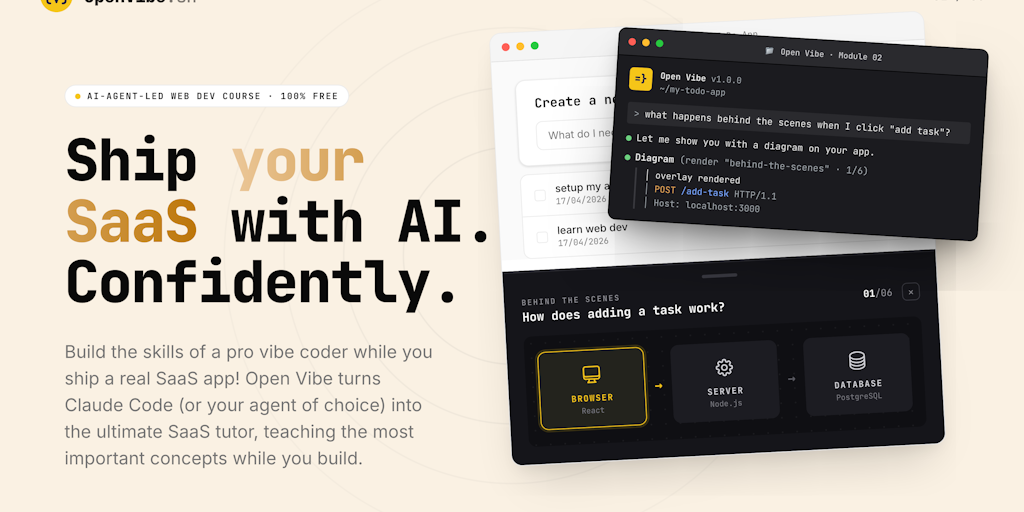
Open Vibe: AI-Powered SaaS Tutor That Guides Users Through Building Full-Stack Apps
Open Vibe is a SaaS-building platform that uses AI agents (like Claude Code) as personalized tutors to guide users through building full-sta
 Product Hunt·27d ago
How AI coding agents are reshaping social science research: Opportunities and concerns
This article examines how AI coding agents are transforming social science research by automating core research tasks traditionally performe
 share.google·4d ago
VibeKit: Open-Source Security Layer for AI Coding Agents
VibeKit is an open-source security tool for developers that provides a safety layer when running AI coding agents like Claude, Gemini, and O
Product Hunt·11mo ago