





















Testing Opus 4.1's NL2SQL capabilities on Netflix streaming data
By
thatjeffsmith

Sesame, salt, and substance. A flagship bake.
Summary
The article evaluates Anthropic's Opus 4.1 LLM for NL2SQL (natural language to SQL) capabilities, specifically testing it on a personal Netflix streaming history dataset. The author argues that generating SQL to answer business questions is a more broadly useful application of LLMs than generating application code. They find that while most LLMs are decent at SQL generation, measurable differences exist between models, and Opus 4.1 performs well in this domain. The piece also touches on the value of combining LLM-generated SQL with MCP (Model Context Protocol) for execution.
Key quotes
· 4 pulledHaving an LLM that can generate good SQL, and have a path to run it (MCP) is going to be a very valuable asset for any organization!
I've found most LLMs to be fairly decent at generating SQL, or even better, generating Oracle's dialect of SQL.
But you WILL find measurable differences between different [LLMs].
Generating application code is cool and all. But, there's a lot more folks out there trying to answer business questions compared to building applications.
You might also wanna read

Exploring the Impact of Large Language Models (LLMs) in Work
The article discusses the author's experience with adopting Large Language Models (LLMs) into their work, specifically highlighting the effi
taras.glek.net·11mo ago
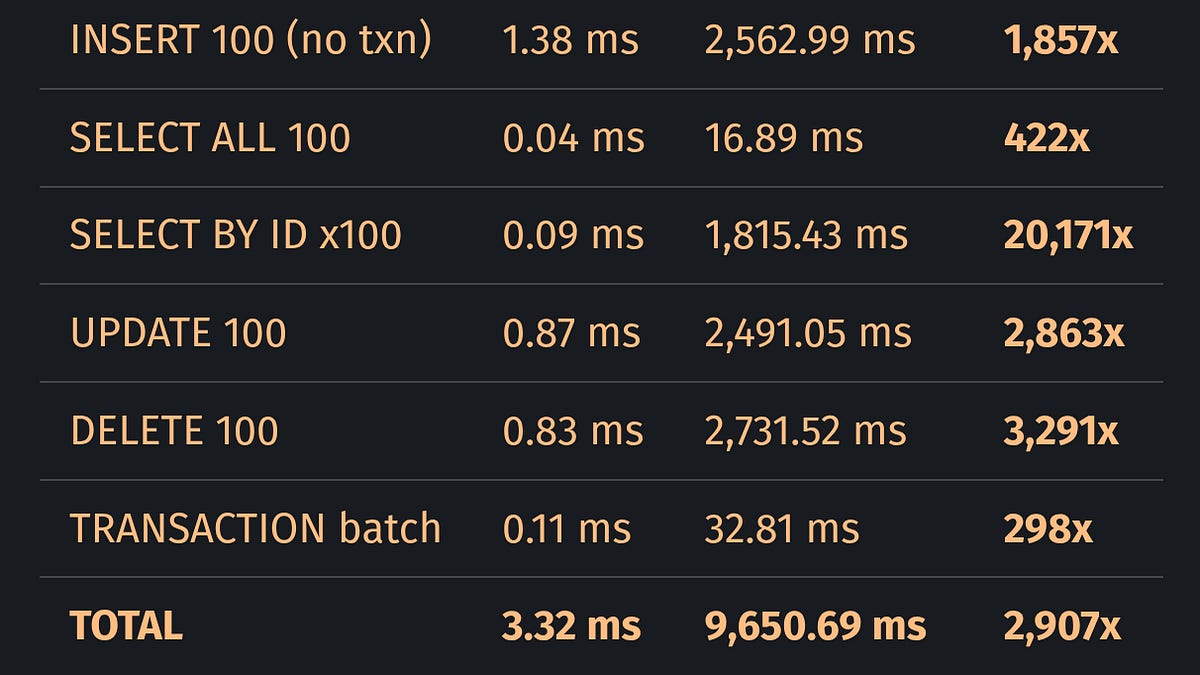
LLM-Generated Code Appears Functional But Performs 20,000x Slower Than SQLite
The article critiques LLM-generated code by comparing a simple database operation between SQLite and an LLM-generated Rust rewrite. While th
 blog.katanaquant.com·2mo ago
Technical Analysis of LLM Inference Engines: Exploring Nano-vLLM Architecture and Scheduling
This article provides an in-depth technical exploration of LLM inference engines, focusing on Nano-vLLM as a case study. It explains the cri
 neutree.ai·3mo ago