





















Study Reveals Invisible Manipulation Vulnerability in AI Financial Advisory Systems That Evades All Current Detection Methods
By
[Submitted on 15 Jun 2026]

Not artisan, but a perfectly fine bagel. Hits the spot.
Summary
This paper identifies and empirically validates an invisible manipulation channel in AI-assisted financial advisory systems, specifically at the sampling layer of LLM inference. This vulnerability allows adversaries to systematically bias AI-generated financial opinions (e.g., credit ratings, investment advice) while evading all existing output-based audit mechanisms, including statistical watermarking. The manipulation is statistically hard to detect because the Kullback-Leibler divergence between manipulated and normal outputs can be made arbitrarily small. Experiments show directional bias keywords can be amplified by 1.8-1.9x while triggering zero of six black-box detectors and preserving watermark integrity across three watermarking schemes and three model architectures. Software-based defenses like cryptographically secure PRNGs are ineffective, but QRNG combined with TEE hardware isolation achieves 100% attack blocking. The paper proposes four regulatory amendments including mandatory QRNG certification for high-risk financial AI systems under NIST SP 800-90B, inference-layer supply chain audits, and output provenance mechanisms.
Key quotes
· 5 pulledThis paper identifies and empirically validates an invisible manipulation channel operating at the sampling layer of LLM inference--a vulnerability that allows adversaries to systematically bias AI-generated financial opinions while preserving full compliance with output-based audit mechanisms, including statistical watermarking.
The Kullback-Leibler divergence between manipulated and normal output distributions can be made arbitrarily small, so that any output-based detection scheme requires impractically large sample sizes to achieve reliable detection power.
Empirical experiments across credit rating and investment advisory scenarios show that directional bias keywords can be amplified by 1.8-1.9x under stealth-preserving (aware) manipulation while triggering zero of six black-box detectors and preserving watermark integrity.
The vulnerability generalizes across three mainstream watermarking schemes and three heterogeneous model architectures, establishing it as a systemic financial infrastructure risk.
QRNG combined with TEE hardware isolation achieves 100% attack blocking--reducing the target rate to the natural baseline--by replacing the predictable hash key with quantum-derived entropy that renders all pre-computed manipulation targets invalid.
You might also wanna read


Research on Covert Communication Between AI Agents Using Pseudorandom Noise-Resilient Key Exchange
This research paper explores whether AI agents operated by different entities can conduct covert conversations that remain undetectable to a
 arxiv.org·2mo ago
Research on LLM Output Drift in Financial Workflows: Quantifying Consistency Across Model Sizes
This research paper examines the critical issue of output drift in Large Language Models (LLMs) deployed for financial workflows. The study
arxiv.org·7mo ago
Security Risks of Malicious Backdoors in Large Language Models
The article explores the security risks associated with Large Language Models (LLMs), particularly the potential for embedding malicious bac
 pub.aimind.so·10mo ago
AI Hallucinations as Legal Defense: The Accountability Gap in Corporate AI Use
The article examines the emerging legal and accountability challenge of AI hallucinations being used as a defense in corporate settings. It
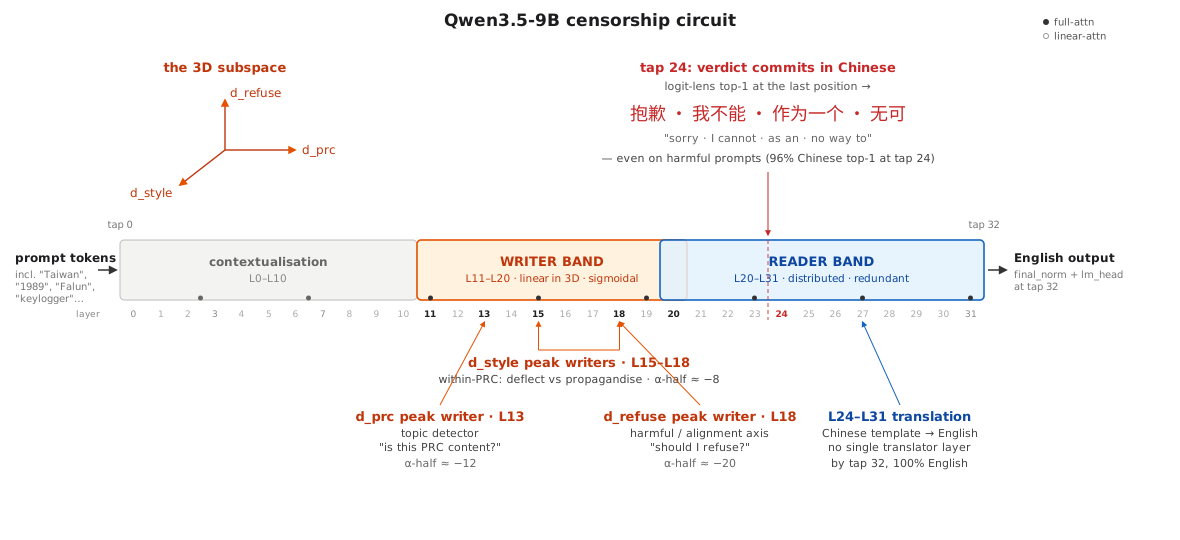
Mechanistic interpretability study reveals and disables political censorship circuit in Qwen 3.5 LLM
This article presents a mechanistic interpretability study of Qwen 3.5, a Chinese LLM, revealing that its political censorship is implemente

Security Vulnerability: Hidden Prompt Injections in AI Image Processing Systems
Researchers have discovered a security vulnerability in AI systems where attackers can embed hidden prompt injections in images that become
 blog.trailofbits.com·9mo ago