





















The Voyager Golden Record: NASA's $1,500 time capsule designed to outlast humanity
By
By Space Daily Editorial Team · Editorial process

Pure flour-power. Hearty enough to carry you through lunch.
Summary
In 1977, NASA attached gold-plated phonograph records to the Voyager spacecraft, containing a curated collection of Earth's sounds, music, greetings in 55 languages, and 115 images. Chaired by Carl Sagan with a tiny budget of about $1,500 and less than six weeks, the committee assembled a time capsule designed to outlast both the spacecraft and potentially human civilization itself. The record includes natural sounds (surf, wind, thunder, birdsong, whales), human sounds (a kiss, a baby, footsteps, laughter), and Ann Druyan's brainwaves, creating a message intended to survive long after the probes fall silent.
Key quotes
· 3 pulledIn the late summer of 1977, NASA bolted a gold-plated copper phonograph record to the side of each of the two Voyager spacecraft.
The committee that chose what went on it, chaired by the astronomer Carl Sagan, had less than six weeks and a tiny working budget, often described as about fifteen hundred dollars.
What they assembled... was 115 images encoded in analog form, greetings in 55 languages, around 90 minutes of music, and a sound essay of Earth: surf, wind, thunder, birdsong, whales, a kiss, a baby, footsteps, laughter.
You might also wanna read

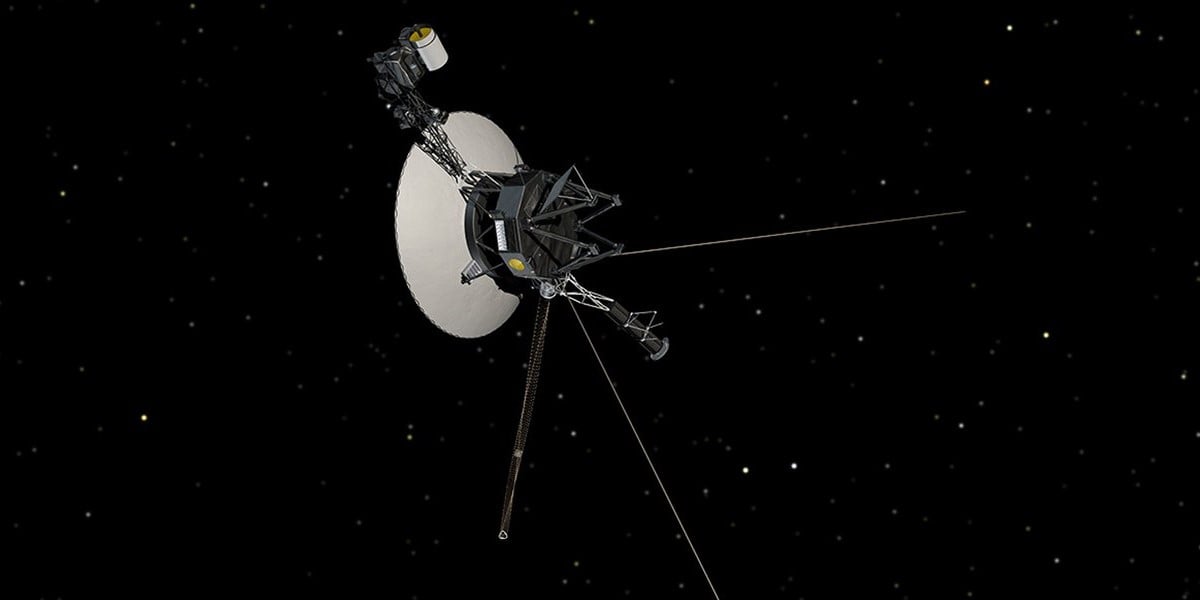
Voyager 1 marks 48 years in space as power-saving measures begin
Voyager 1, launched 48 years ago from Cape Canaveral, continues its mission studying Jupiter, Saturn, and Titan's atmosphere. Despite its ag
 theregister.com·9mo ago
Debunking the myth: Voyager spacecraft software and the aging engineer problem
The article fact-checks the popular narrative that NASA's Voyager spacecraft run on software written in a programming language that nobody a
 spacedaily.com·26d ago
NASA Disables Voyager 1's LECP Instrument to Conserve Power for Extended Mission
NASA engineers have shut down the Low-energy Charged Particles (LECP) instrument on Voyager 1 to conserve power and extend the spacecraft's
 science.nasa.gov·1mo ago
Voyager 1 to Reach One Light-Day Distance from Earth by November 2026
NASA's Voyager 1 spacecraft, launched in 1977, is approaching a historic milestone where it will be exactly one light-day from Earth by Nove
 scienceclock.com·6mo ago
NASA's Voyager Probes Encounter 'Wall of Fire' at Solar System's Edge
NASA's Voyager probes encountered a 'wall of fire' at the edge of the Solar System, measuring temperatures of 30,000-50,000 kelvin. The boun
iflscience.com·11mo ago
Earth's Expanding Radio Bubble: How Humanity's Signals Are Reaching the Cosmos
This article explores the concept of Earth's "radio bubble" — a sphere of electromagnetic radiation expanding outward at the speed of light
 thescientificdrop.com·26d ago