





















Implementing Stack Operations in Prolog Using Definite Clause Grammars (DCGs)
By
triska

A respectable bake. You'd come back tomorrow for another.
Summary
The article demonstrates how to implement stack-based operations in Prolog using Definite Clause Grammars (DCGs). It shows how to create stack manipulation operations like pop, push, dup, swap, nip, over, and arithmetic operations (add, sub, mul, div, power, negate) using DCG syntax. The author draws parallels between these Prolog DCG implementations and Forth's stack notation, showing how Prolog can be used to create a stack-based programming language within its logical programming paradigm.
Key quotes
· 5 pulledpop --> [_].
dup, [A,A] --> [A].
swp, [B,A] --> [A,B].
add, [C] --> [A,B], {C is A+B}.
These are basically equivalent to Forth's stack signature but instead of dup ( a -- a a ) we're saying dup, [A,A] --> [A].
You might also wanna read

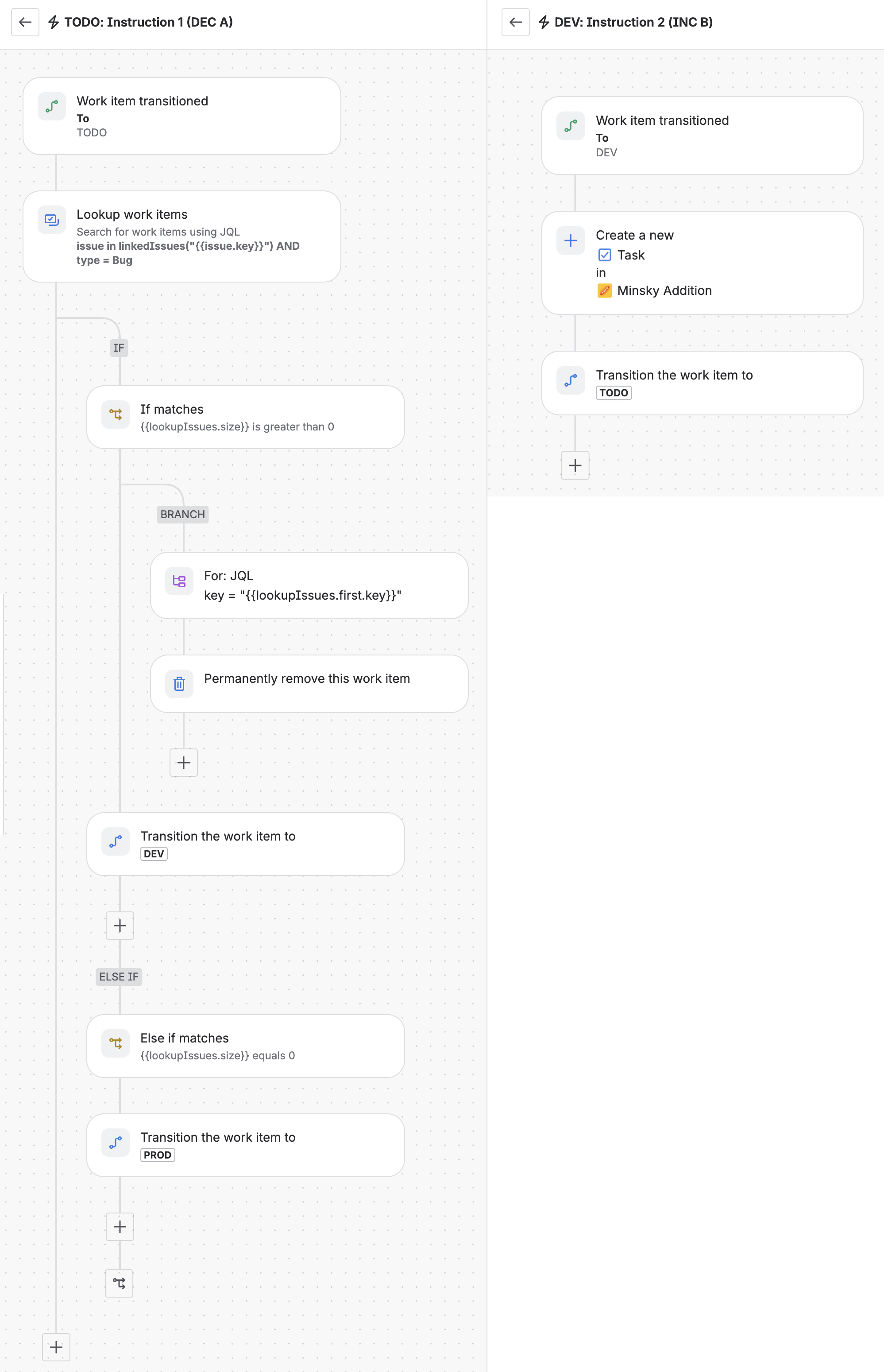
A Formal Proof That Jira Is Turing-Complete via Minsky Machine Implementation
This article provides a formal proof that Jira (Atlassian's project-tracking tool) is Turing-complete by demonstrating how to build a Minsky
A Formal Proof That Jira Is Turing-Complete via Minsky Machine Implementation
This article provides a formal proof that Jira (Atlassian's project-tracking tool) is Turing-complete by demonstrating how to build a Minsky

How Shamir's Secret Sharing Algorithm Enables Threshold Cryptography
This article explains Adi Shamir's Secret Sharing algorithm, a cryptographic method published in 1979 that splits a secret into multiple pie
 ente.com·6d ago
The History of Pipes, Forks, and Zombies in Unix Systems
This article discusses the history and concept of pipes in Unix systems, focusing on Doug McIlroy's original vision of coupling programs lik

Demystifying Floating Point Numbers: An Interactive Guide
An in-depth technical blog post that demystifies floating point numbers, explaining their internal representation and behavior. The author i
 ciechanow.ski·1mo ago
Survey of Fast Hyperbolic Tangent Approximation Techniques for Neural Networks and Audio Processing
This article surveys various mathematical approximation techniques for the hyperbolic tangent (tanh) function, focusing on computational eff