





















Exploring Human-Like Reasoning Through Model Synthesis Architecture
By
PaulHoule

Crackling crust, pillowy middle. The kind of bagel that earns a second cup of coffee.
Summary
The article explores how people synthesize probabilistic models to handle novel situations by combining distributed and symbolic representations. It introduces a 'Model Synthesis Architecture' (MSA) that uses language models for relevance-based retrieval and probabilistic programs for coherent reasoning. The MSA is evaluated against human judgments in a 'Model Olympics' dataset, demonstrating its effectiveness in open-ended reasoning.
Key quotes
· 4 pulledWhen faced with novel situations, people are able to marshal relevant considerations from a wide range of background knowledge and put these to use in inferences and predictions.
We propose a computational implementation of this idea -- a 'Model Synthesis Architecture' (MSA) -- using language models to implement global relevance-based retrieval and model synthesis and probabilistic programs to implement bespoke, coherent world models.
Our MSA approach captures human judgments better than language model-only baselines, under both direct and chain-of-thought generations from the LM that supports model synthesis.
These results suggest that MSAs can be implemented in a way that mirrors people's ability to deliver locally coherent reasoning over globally relevant variables.
You might also wanna read

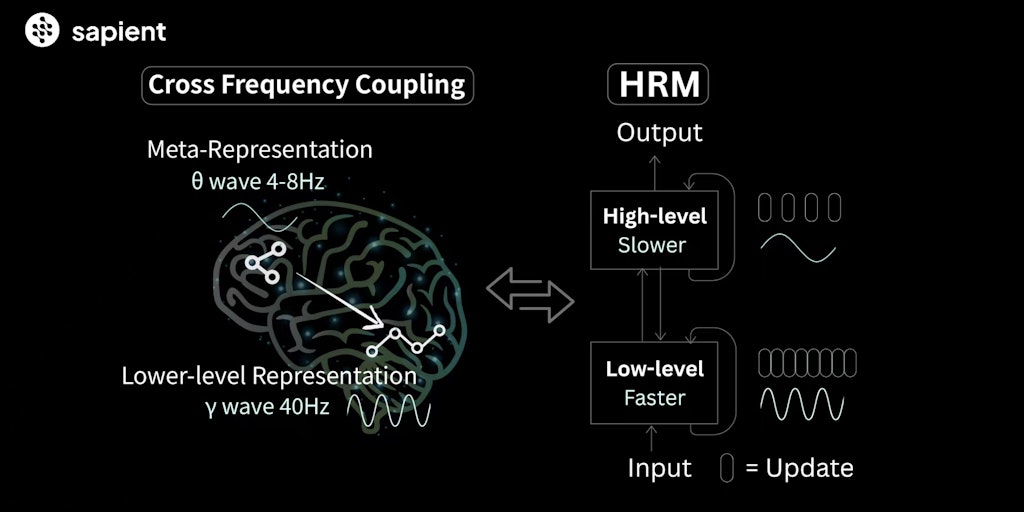
Revolutionary 27M-Parameter AI Model Enhances Sequential Reasoning and Planning
The article introduces a revolutionary 27M-parameter AI model called the Hierarchical Reasoning Model, which performs complex sequential rea
 Product Hunt·10mo ago
Researchers Develop Method to Predict Real-Time Progress in Reasoning Language Models
This research paper investigates whether real-time progress prediction is feasible for reasoning language models that use long latent chains
 arxiv.org·4d ago