





















Bayesian Gaussian Process Modeling for Uncertain Spatial Coordinates Using PyMC
By
ckrapu

Toasted golden, schmeared with insight. Top of the rack.
Summary
This article discusses the use of Bayesian spatial probability models, specifically Gaussian processes (GPs), for handling data with uncertain or unknown spatial coordinates. It uses the mining industry as a motivating example, where prospectors take geologic samples to detect mineral resources, but often lack precise location data for those samples. The article explains how PyMC can be used to implement Gaussian process models that account for uncertainty in spatial coordinates, allowing for more robust inference when coordinate data is missing or imprecise.
Key quotes
· 3 pulledAn especially strong motivating case for the usage of spatial probability models comes from the mining industry.
These data typically show strong spatial correlation, but constructing a fully-detailed geophysical model is at times infeasible as we are able to observe very little of the underground conditions.
The advent of remote sensing techniques like ground-penetrating radar and gravimetry has dramatically improved our ability to infer subsurface structures.
You might also wanna read

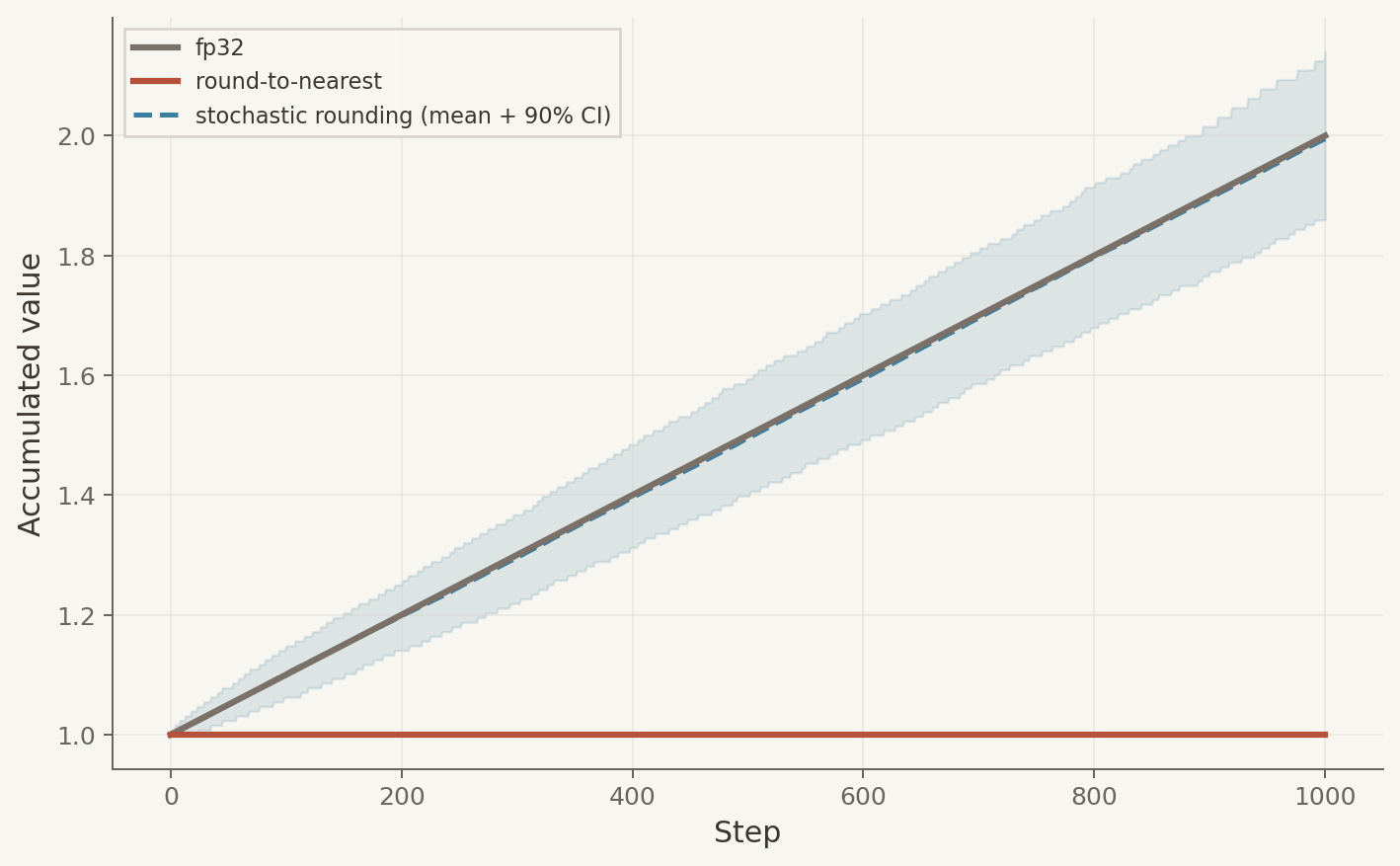
Why Stochastic Rounding Prevents Error Accumulation in Low-Precision Arithmetic
This article explains the critical difference between round-to-nearest and stochastic rounding in low-precision floating-point arithmetic (B
 convergentthinking.sh·2d ago
Cleve Moler, MATLAB Creator and MathWorks Cofounder, Dies at 86
Cleve Moler, cofounder of MathWorks and creator of the MATLAB programming language, passed away on May 20, 2026, at age 86. Moler was a math
 mathworks.com·10d ago
ERA: A tree-search-based scientific coding tool for computational discovery
ERA (Empirical Research Assistance) is a versatile tool for scientific coding that can search scientific literature, write code, explore sol
 research.google·12d ago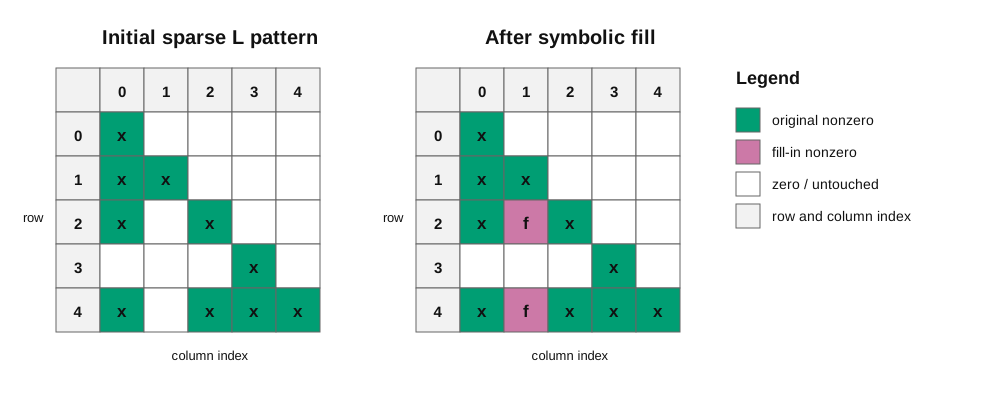
Deriving the Sparse Cholesky Elimination Tree for Matrix Factorization
This article provides a technical derivation of the elimination tree for the right-looking sparse Cholesky algorithm (A = LL^T) for sparse m

GitHub Repository: 300-Line Implementation of Computational Life Research on Self-Replicating Programs
This article describes a GitHub repository containing a 300-line code reproduction of computational life research, where self-replicating pr
 github.com·2mo ago
ETH Zurich Research Questions Effectiveness of AGENTS.md Files for AI Coding Agents
ETH Zurich researchers published a paper challenging the value of AGENTS.md files for AI coding agents, finding they often hinder rather tha
 infoq.com·2mo ago