





















Depth hierarchy theorem proves increasing depth strictly increases power in constant-depth quantum circuits
By
[Submitted on 15 Jun 2026]

Solid neighbourhood-bakery energy. Trustworthy and warm.
Summary
This paper proves an explicit depth hierarchy theorem for QNC^0 (constant-depth quantum circuits). For each depth d ≥ 12, the authors construct two-round interactive problems that depth-(d-1) quantum circuits cannot solve with near-perfect success, regardless of gate set, circuit size, or ancillary qubits. The construction can be realized by slightly deeper quantum circuits. Additionally, all bounded fan-in classical circuits of sublogarithmic depth fail on these tasks, demonstrating unconditional quantum advantage of QNC^0 over NC^0. The work develops new lower bound techniques by analyzing how depth affects a circuit's ability to realize nonlocal correlations, using constraint systems and nonlocal games to translate group-theoretic constructions into depth lower bounds.
Key quotes
· 5 pulledWe prove an explicit depth hierarchy theorem for $\mathsf{QNC}^0$.
For each $d\ge 12$, we construct a family of two-round interactive problems on which no depth-$(d-1)$ quantum circuit can achieve near-perfect success, regardless of gate set, circuit size, or ancillary qubits.
A key obstacle is the scarcity of lower bound techniques for quantum circuits.
These results show that increasing depth strictly increases computational power within $\mathsf{QNC}^0$, establishing a genuinely quantum hierarchy.
All bounded fan-in classical circuits of sublogarithmic depth (in the input size) fail to achieve perfect success on these tasks for every $d$, yielding a hierarchy of problems that show unconditional quantum advantage of $\mathsf{QNC}^0$ over $\mathsf{NC}^0$.
You might also wanna read

Sublinear-Space ZKP System in Rust: Streaming Prover with O(√T) Memory via KZG Commitments
A reference implementation of a sublinear-space zero-knowledge proof (ZKP) prover/verifier system in Rust, based on a whitepaper. The stream
 github.com·8mo ago
Demonstration of Algorithmic Quantum Speedup for an Abelian Hidden Subgroup Problem
journals.aps.org·11mo agoUsing Wave Function Collapse to solve puzzle map generation at scale
A Classical RAM Design That Mimics Quantum Collapse and Entanglement"
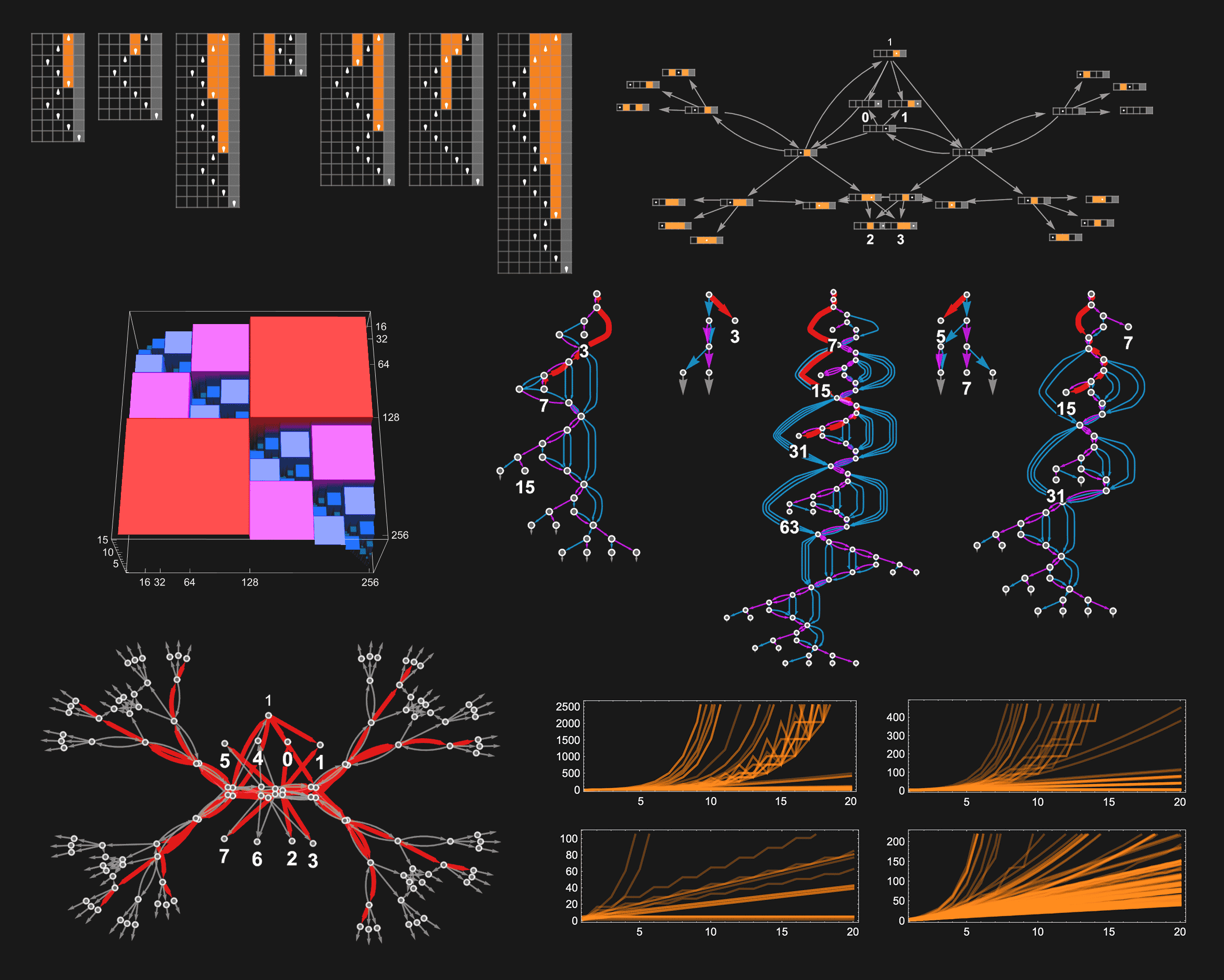
Exploring Computational Complexity: A Ruliological Approach to the P vs. NP Problem
The article explores computational complexity theory and the P vs. NP problem through a 'ruliological' approach, examining why fundamental q
 writings.stephenwolfram.com·4mo ago