





















Book Club Selects 'The Art of Multiprocessor Programming 2nd Edition' for Discussion
By
eatonphil

Properly proved. Has structure, has flavour, has a point.
Summary
The article announces the selection of 'The Art of Multiprocessor Programming 2nd Edition' for a book club, providing details about the book's edition and a schedule for chapter discussions. It also mentions the availability of a free PDF of the 1st edition but advises readers to ensure they access the 2nd edition.
Key quotes
· 3 pulledThe next book we'll read is The Art of Multiprocessor Programming 2nd Edition (ISBN 9780124159501) from 2020 by Herlihy, Shavit, Luchangco, and Spear.
A free PDF comes up for me on a Google search of this book but it is of the 1st Edition from 2008. Make sure you grab the 2nd Edition from 2020.
August 16th: Phil - Chapter 1: Introduction
You might also wanna read

The Decline of Programming Books: How Digital Learning Replaced the Classic Tech Tome
A nostalgic reflection on the decline of traditional programming books (like O'Reilly's animal-covered series) in favor of online tutorials,
 unix.foo·6d ago
Mastering Dyalog APL Book Being Updated with Jupyter Notebooks
This article discusses the "Mastering Dyalog APL" book, which is considered the standard resource for learning Dyalog APL. It notes that the
Awesome CUDA Books: A Curated List of GPU Programming Resources
A curated GitHub repository listing major CUDA programming books ranging from beginner to advanced levels. The list covers C++/Python approa
 github.com·14d ago
Introduction to 'The Genius Of Lisp' Book About Programming Language History
This article introduces 'The Genius Of Lisp,' a book by Cees de Groot about the history of the Lisp programming language, described as 'argu
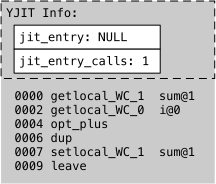
Author Working on New Edition of "Ruby Under a Microscope" Covering Ruby 3.x JIT Compilers
The author is working on a new edition of "Ruby Under a Microscope" covering Ruby 3.x, with a focus on JIT compilers (YJIT and ZJIT). The ar
 patshaughnessy.net·6mo ago
Building a Minimal RAG System from Scratch: PDF to Highlighted Answers in ~100 Lines of Python
A hands-on tutorial that builds the smallest functional RAG (Retrieval-Augmented Generation) system from scratch using about 100 lines of Py
 towardsdatascience.com·1d ago