





















AI Adoption Doesn't Have to Mean Layoffs: Schneider Electric's Productivity-First Approach
By
Patricia Cohen, Alexis Pazoumian

A weekday bagel. Dependable, satisfying, no fuss.
Summary
The article challenges the prevailing CEO mindset that AI adoption should primarily focus on job elimination. It highlights Stanford's Erik Brynjolfsson, who argues this view reflects a narrow understanding of AI's potential. The piece uses Schneider Electric as a case study, showing how the French multinational uses AI in manufacturing to enhance worker productivity rather than replace employees, offering an alternative approach to AI implementation.
Key quotes
· 3 pulledA lot of people are under the mistaken idea that the only way that you get productivity from
a very narrow understanding of A.I.'s potential
lower-value human capital
You might also wanna read


AI Adoption Boosts European Firm Productivity by 4% Without Short-Term Job Losses
This article examines the impact of AI adoption on European firms using survey data from over 12,000 companies. The research finds that AI a
 cepr.org·3mo ago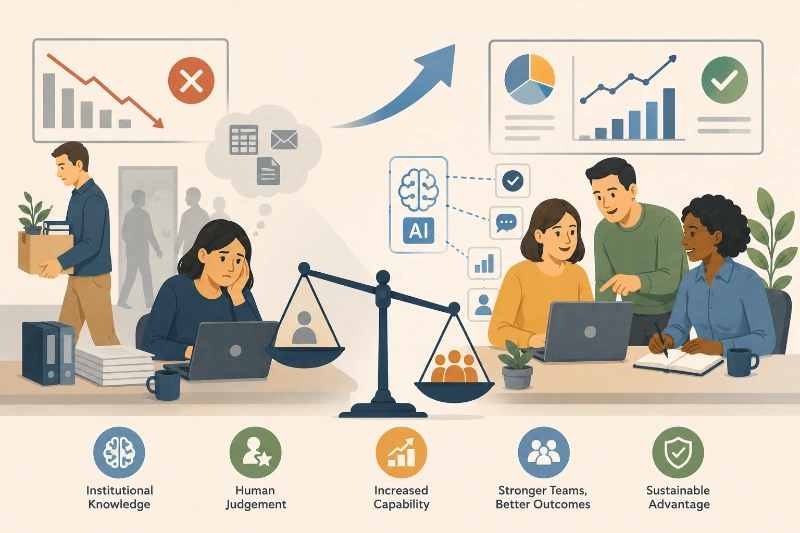
Why Companies Cutting Jobs for AI Will Lose to Those Investing in Their Teams
The article argues that companies using AI adoption as a justification for cutting headcount are making a strategic error. While reducing pa
 libertas.software·9d ago
AI Productivity in Software Development: Reducing Headcount vs. Building Better Products
A Hacker News discussion about the impact of AI productivity gains on software development, exploring whether companies should use AI to red
 news.ycombinator.com·2mo ago
The Case for AI Executive Officers: Why AI Should Replace CEOs, Not Just Developers
The article introduces the concept of the AI Executive Officer (AEO) and the A-suite (AxOs), proposing that AI should replace CEOs and other

AI's Economic Impact Should Focus on Output Growth, Not Just Profit Distribution
The article argues that the economic impact of AI should be measured by its effect on output and productivity rather than just focusing on w
 scottsumner.substack.com·4mo ago
AI Should Elevate Engineering Thinking, Not Replace It
The article discusses how software engineering is evolving with AI, splitting engineers into two groups: those who do everything themselves
 koshyjohn.com·1mo ago