





















Why Access Controls Fail for AI Agents: The Intent Validation Gap
By
Alex Vakulov

The kind of bagel that ruins lesser bagels for you.
Summary
The article argues that traditional access controls are insufficient for AI agents because they validate identity and permissions but cannot validate intent or determine whether an action is sensible. As AI agents increasingly operate autonomously within enterprise environments—calling tools, triggering workflows, and making decisions—this gap creates a critical security vulnerability. The author contends that current security stacks were not designed for AI agents, and the rapid transition from experimental to production-ready AI tools has outpaced security measures. The piece calls for new security paradigms that can assess the context and reasonableness of actions, not just who or what initiated them.
Key quotes
· 5 pulledAccess controls can confirm who or what is allowed to act. They cannot always tell whether the action makes sense.
That gap becomes dangerous with AI agents, which can call tools, trigger workflows, and make decisions.
The problem is that agents may do all this before anyone gets the chance to read the output or decide whether it was a good idea.
There is a real vulnerability in the fact that the industry did not design its security stacks to deal with AI agents.
AI agents quickly went from an interesting experiment to tools already running inside your environment.
You might also wanna read

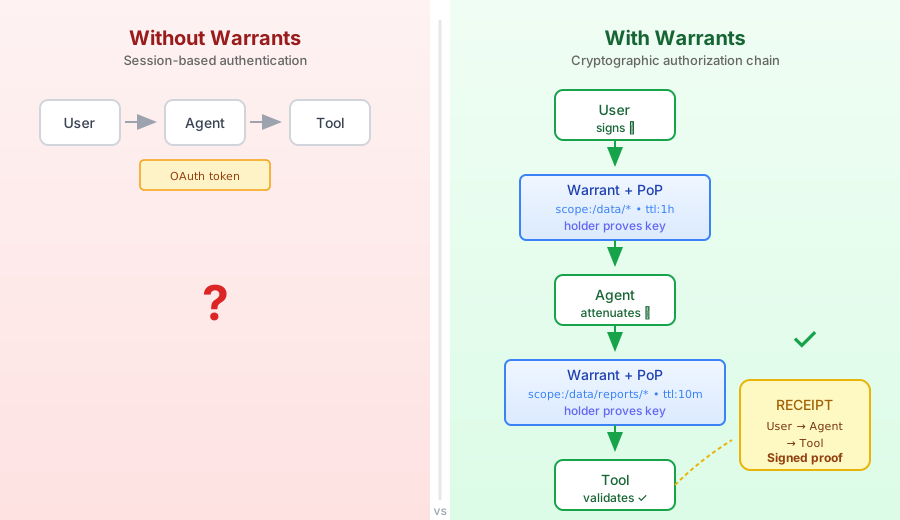
AI Hallucinations as Legal Defense: The Accountability Gap in Corporate AI Use
The article examines the emerging legal and accountability challenge of AI hallucinations being used as a defense in corporate settings. It

AI Agent Security: Why Permissions Matter More Than Sandboxes for OpenClaw Threats
The article discusses the real-world dangers of AI agents like OpenClaw, which has caused significant harm including deleting user inboxes,
 tachyon.so·3mo ago
Security concerns grow as AI agents gain unfettered access to desktop operating systems
The article discusses the security risks of giving AI agents unfettered access to control desktop operating systems. The author expresses un
sophiebits.com·9mo ago
Security Vulnerabilities in Agentic AI Browsers: Testing Reveals Scam Susceptibility
The article examines the emerging security vulnerabilities in agentic AI browsers that autonomously browse, search, and interact online. It
 guard.io·9mo ago
Designing Transparency for Agentic AI Systems: Finding the Right Moments for Clarity
This article explores the design challenges of agentic AI systems, focusing on how to provide appropriate transparency without overwhelming
 Smashing Magazine·2mo ago
AI Security: Why You Should Treat AI Agents as Untrusted and Build for Containment
The article argues that AI agents should be treated as inherently untrusted and potentially malicious, advocating for security architectures
 nanoclaw.dev·3mo ago