





















PR-CAD: A Unified LLM-Based Framework for Controllable Text-to-CAD Generation and Editing
By
[Submitted on 27 Mar 2026]

Crispy enough to crunch, soft enough to enjoy. A good bake.
Summary
This paper introduces PR-CAD, a progressive refinement framework that unifies text-to-CAD generation and editing using large language models. The authors curate a high-fidelity interaction dataset covering the full CAD lifecycle with multiple representations and both qualitative/quantitative descriptions. They propose a reinforcement learning-enhanced reasoning framework that integrates intent understanding, parameter estimation, and edit localization into a single agent, enabling both design creation and refinement. Experiments show state-of-the-art controllability and faithfulness on public benchmarks, with mutual reinforcement between generation and editing tasks.
Key quotes
· 4 pulledWe propose PR-CAD, a progressive refinement framework that unifies generation and editing for controllable and faithful text-to-CAD modeling.
Building on a CAD representation tailored for LLMs, we propose a reinforcement learning-enhanced reasoning framework that integrates intent understanding, parameter estimation, and precise edit localization into a single agent.
Extensive experiments demonstrate strong mutual reinforcement between generation and editing tasks, and across qualitative and quantitative modalities.
On public benchmarks, PR-CAD achieves state-of-the-art controllability and faithfulness in both generation and refinement scenarios, while also proving user-friendly and significantly improving CAD modeling efficiency.
You might also wanna read


ShapeLib: Using LLMs to Design Programmatic 3D Shape Abstraction Libraries
ShapeLib is a novel method that leverages Large Language Models (LLMs) to design libraries of programmatic 3D shape abstractions. The system
 arxiv.org·7d ago
RICP: A Teacher-Student Framework for Retrieved In-Context Principles from Mistakes in LLMs
This paper introduces Retrieved In-Context Principles (RICP), a novel teacher-student framework for improving Large Language Models (LLMs) t
arxiv.org·13d ago
Microsoft Research's ARTIST: Using Reinforcement Learning to Train LLM Agents for Dynamic Tool Use
Microsoft Research's ARTIST framework uses reinforcement learning to train LLM agents to discover when and how to call tools (like search or
 dev.to·13d ago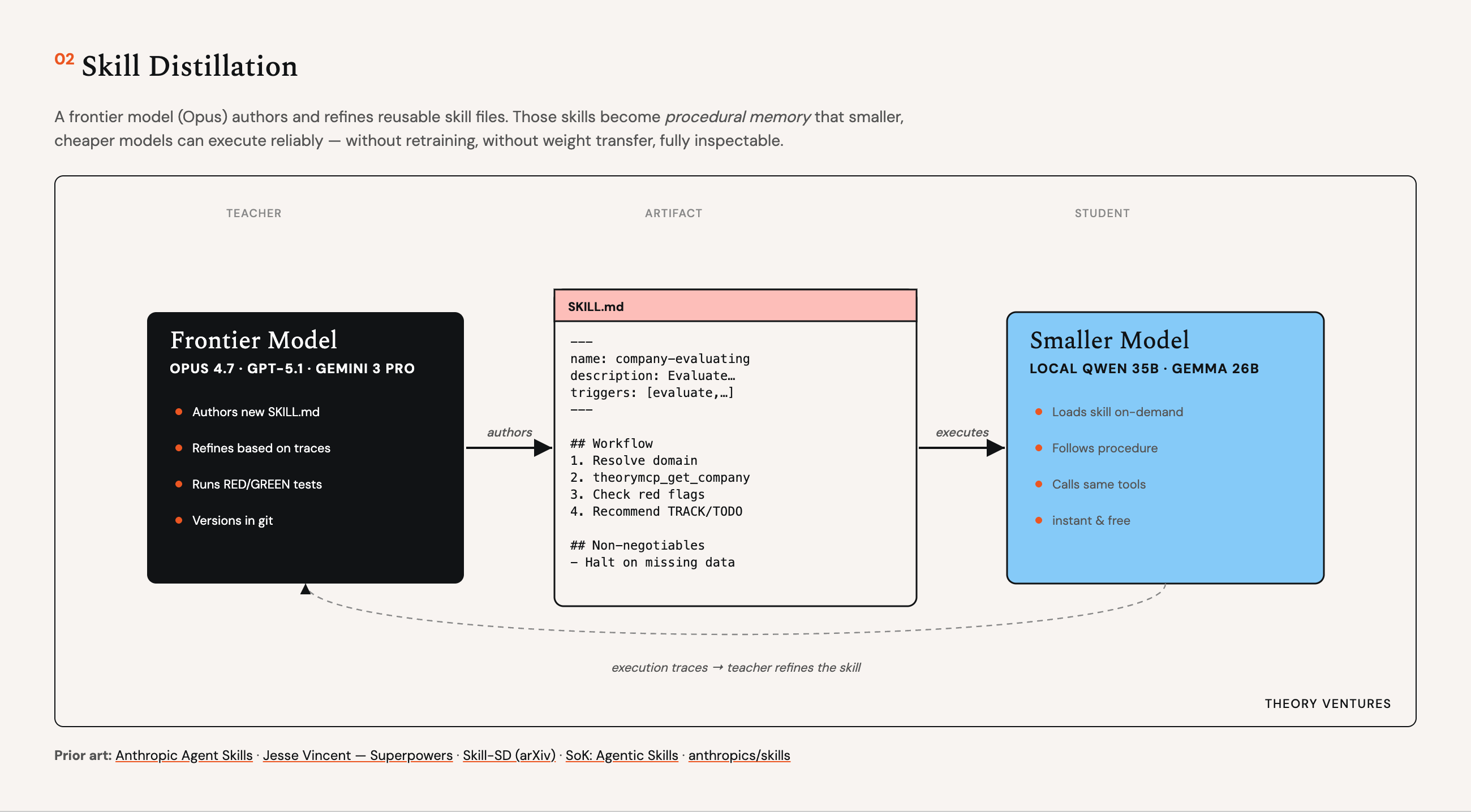
Building a Personal AI Agent with Markdown-Based Skills and Local Models
The article describes a personal AI agent built on Pi that manages the author's inbox, calendar, deal pipeline, blog publishing, and researc
 tomtunguz.com·10d ago
EvoTrainer: A Framework for Co-Evolving LLM Policies and Training Harnesses in Autonomous Agentic Reinforcement Learning
The article introduces EvoTrainer, an autonomous training framework for LLMs that goes beyond traditional recipe search by co-evolving both
arxiv.org·6d ago
Eureka: An LLM-Driven Framework for Automated Feature Engineering in Enterprise AI
This paper presents Eureka, an LLM-driven framework for automated feature engineering in machine learning. It treats feature engineering as
arxiv.org·13d ago