





















GPU-Accelerated Classical Simulation Narrows Quantum Advantage Claim for Fermi-Hubbard Model
By
[Submitted on 3 Jun 2026]

Not artisan, but a perfectly fine bagel. Hits the spot.
Summary
This paper challenges Q-CTRL's claimed 3000× quantum advantage for simulating 1D Fermi-Hubbard quench dynamics. The authors used GPU-accelerated tensor contractions and full U(1)×SU(2) symmetry to achieve classical simulations with bond dimensions up to χ≈62,000 on four NVIDIA H200 GPUs—15× larger than Q-CTRL's classical baseline. They achieved fully converged results across the entire simulation window (including the previously unresolved high-entanglement regime t∈[5.2,6]) and advanced the classical frontier to t=7, beyond the quantum experiment. At comparable bond dimensions, their GPU implementation completed in ~100 minutes, reducing the claimed 3000× quantum advantage to ~36×.
Key quotes
· 4 pulledReaching bond dimensions up to χ≈62,000 on four NVIDIA H200 GPUs — among the largest ever achieved in TDVP simulations and fifteen times larger than Q-CTRL's classical baseline — we achieve fully converged results across the entire simulation window.
At the bond dimension comparable to Q-CTRL's best classical run, our GPU implementation completes in ~100 minutes, directly reducing the claimed 3000× quantum advantage to ~36×.
These results substantially narrow the quantum-classical performance gap and establish a new standard for tensor-network benchmarking of large-scale quantum simulations.
We further advance the classical frontier to t=7, which lies beyond the quantum hardware experiment and any previously verified classical evolution of the full wavefunction.
You might also wanna read
WebGPU-Based 2D Coulomb Gas Simulator: Visualizing Electron Interactions and Log-Gas Hamiltonian
The article describes a 2D Coulomb gas simulator built with WebGPU technology, where each dot represents an electron experiencing pairwise C

Demonstration of Algorithmic Quantum Speedup for an Abelian Hidden Subgroup Problem
journals.aps.org·11mo ago
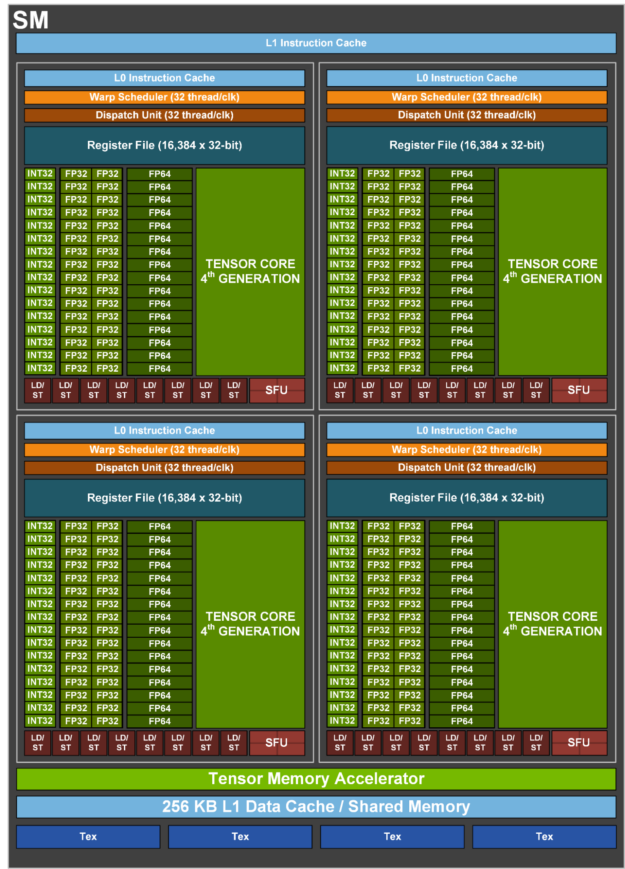
Re-evaluating Warp Specialization for Modern Tensor Core GPUs
This technical blog post examines the necessity of warp specialization for high-performance kernels on modern Tensor Core GPUs like NVIDIA's
 rohany.github.io·8mo ago
Experimental WebGPU Physics Engine Using AVBD Solver for Rigid-Body and Soft-Body Simulations
This article presents an experimental WebGPU physics engine called webphysics that implements an AVBD-style (Augmented Vertex Block Descent)
 github.com·2mo ago
Nanocrystal Light Emission Reveals Quantum Zero-Point Motion in Atomic Lattice
Researchers have observed unexpected light emission from a nanocrystal cooled to near absolute zero, which is shown to arise from quantum fl
 physics.aps.org·7mo ago