





















WashU Medicine researchers develop AI system to interpret 3D retinal scans for faster disease diagnosis
By
Marta Wegorzewska

Hand-rolled, kettle-boiled, baked to perfection. Worth every minute at the bakery.
Summary
Researchers at WashU Medicine have developed an experimental AI system that interprets 3D images of the eye's retina to help diagnose retinal diseases faster. The AI analyzes non-invasive eye scans (OCT images) to detect signs of disease, potentially speeding up both clinical diagnosis and drug trials by providing more efficient analysis of retinal imaging data.
Key quotes
· 3 pulledNon-invasive eye scans allow doctors a zoomed-in, three-dimensional look beneath the eye's surface without causing discomfort or pain to the patient.
Programs that analyze eye images could also speed up drug trials, study finds.
Each 3D image of the retina is composed of hundreds of 2D slices.
You might also wanna read

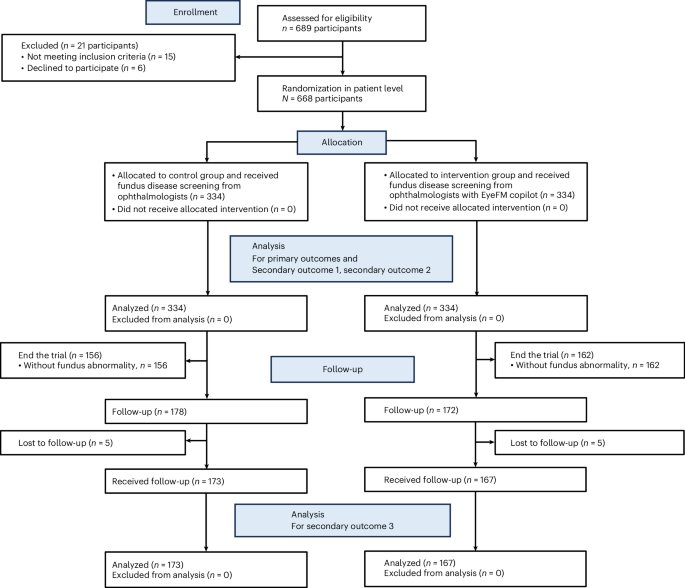
AI Foundation Model Improves Ophthalmologist Diagnostic Accuracy in Randomized Controlled Trial
Researchers developed EyeFM, a multimodal vision-language eyecare foundation model trained on 14.5 million ocular images from global dataset
 nature.com·9mo ago
MIRA Vision: AI-Powered Pathology Analysis Platform Using Synthetic Data
MIRA vision is an AI-powered pathology analysis platform that uses synthetic data to improve medical diagnostics. The platform aims to enhan
 Product Hunt·1mo ago
All-Optical Chip Enables Large-Scale AI Semantic Vision Generation
Researchers have developed an all-optical synthesis chip that addresses the computing power shortage in large-scale generative AI models. Th
 science.org·5mo ago
Harvard study finds AI outperforms doctors in emergency triage diagnoses
A Harvard study found that AI systems outperformed human doctors in emergency medicine triage, diagnosing more accurately in high-pressure s
 The Guardian·1mo ago
FDA's AI for Drug Approvals Found to Fabricate Studies
The FDA's AI system, designed to expedite drug approvals, has been discovered to generate fake studies and misrepresent research, raising co
 The Onion·10mo ago
Why AI isn't replacing radiologists: The limits of automation in medical imaging
The article discusses how AI systems like CheXNet can detect pneumonia from chest X-rays with greater accuracy than board-certified radiolog
 worksinprogress.news·8mo ago